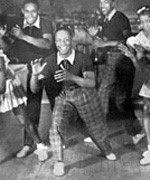
George Snowden was one of the founding fathers of Lindy Hop, a Harlem based dancer and choreographer who performed extensively throughout the 1930s. He broke both of his ankles ice-skating as a teen and was told he’d never dance again. Despite this, by the late 1920’s he had established a reputation as one of the best and fastest Charleston dancers in Harlem. Shorty George was the reigning champion of the earliest Lindy hop competitions and started the first professional Lindy Hop troupe, the Shorty Snowden Dancers, who performed with the Paul Whiteman Orchestra at the Paradise Club through most of the 1930s.
Snowden was only 5’ tall but his small stature certainly didn’t hold him back. He frequently performed with a tall partner known as Big Bea (Beatrice Gay). They often ended their routines with Bea throwing Shorty into the air or carrying him off stage on her back. The Shorty George jazz step is named after Snowden—it was one of his signature moves. In case you’re wondering Count Basie’s ‘Shorty George’ is not about George Snowden but instead about a figure from folklore with the same name.
In addition to being one of the greatest Lindy Hoppers of all time, Shorty George is often credited with coming up with the name ‘Lindy Hop’ and sometimes credited with creating the dance. While I had heard the naming story a lot, I was more interested in learning about the formative influence that he had on the dance. In the summer of 1928 Shorty George and his partner Mattie Purnell took the gold prize in a dance marathon. According to the news report, they had performed ‘the fanciest performance of a new dance called the “Lindbergh Hop”’. Reportedly, what they did in the competition that really wowed the audience was to let go of one hand, breaking away from each other momentarily and then coming back together. Supposedly this was a mistake that was gracefully covered with fancy footwork.
There seems to be some debate about the exact moment that the term Lindy Hop was coined, whether or not Lindbergh Hop was a separate dance, and whether or not a breakaway move already existed. However, George Snowden seems to have been well respected by other dancers from that time. It seems that what made him such an important figure in lindy hop history isn’t so much what happened at that one competition but how he continued to develop that crowd pleasing breakaway into the signature move of Lindy Hop – the swing out. Shorty George and Mattie Purnell became known for their specific style of breaking away and they continued to explore and to demonstrate the rich potential that the break away step offered for both leaders and followers to improvise footwork. The freedom of the swing out allowed dancers to accentuate the elongated rhythms that bands were experimenting with as swing music developed alongside the dance and George Snowden was at the forefront of making Lindy Hop not just one fancy step but an international dance craze that keeps coming back.
Shorty George was a bit older than some of the Savoy dancers more familiar to Lindy Hoppers today and crippling arthritis prevented him from dancing as much as he might have later in life. Sadly, we don’t have much in the way of first hand accounts from George Snowden (who passed away in 1982) but there are a couple of good videos of his dancing including this clip from the film After Seben which shows him dancing with Mattie Purnell, doing their signature break away move and the one below of Shorty George and Big Bea.
Further Reading
The Creators of The Lindy Hop: George ’Shorty’ Snowden and Mattie Purnell
Jassdancer feature on George Snowden
 Swing Dance Leeds